“A loan file rarely tells the whole story. Sometimes, the thickest files hide the biggest lies.”
Introduction
Every banker knows the satisfaction of approving a well-documented loan proposal. A file containing audited financial statements, GST returns, tax records, property valuations, and detailed project reports/CMA data projects an aura of absolute transparency. On paper, the case appears flawless.
Yet history has repeatedly shown that some of the largest banking frauds were supported by equally impressive documentation.
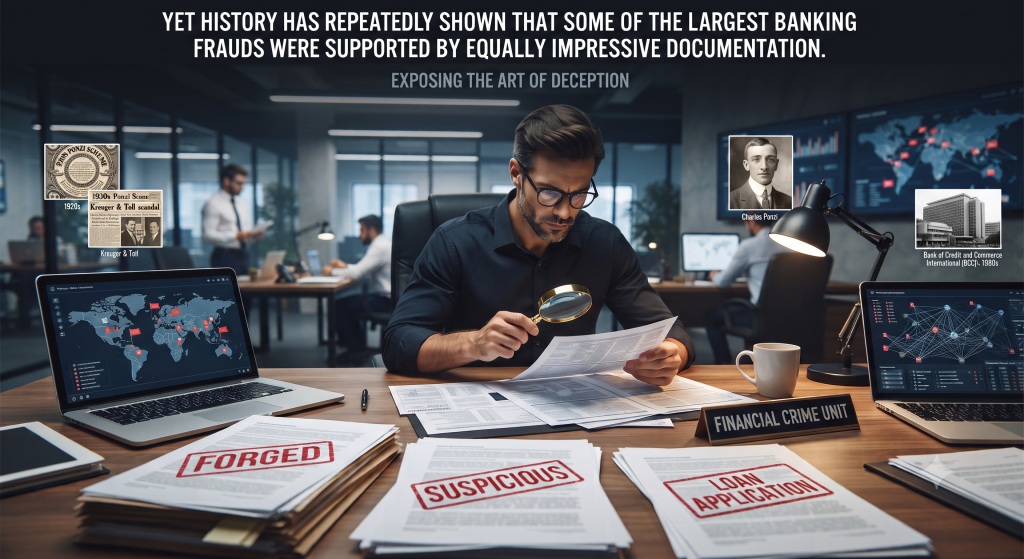
The uncomfortable truth is that fraudsters rarely submit incomplete files.
Instead,
they submit perfect ones.
The most dangerous loan frauds are not those with missing documents but those with convincing documents that conceal fabricated realities.
This article explores how seemingly genuine loan proposals evolve into major frauds, why even experienced bankers can be deceived, and what lessons every credit officer, auditor, and risk manager should remember.
The Perfect Borrower
Imagine a borrower named Arjun Enterprises.“The persona of Arjun Enterprises is entirely illustrative, bearing no relation to any actual person, living or deceased.”
Additionally, the company has been in business for eight years.
Moreover, annual turnover has steadily increased.
Additionally, audited balance sheets reflect healthy profits.
Additionally, GST returns match reported sales.
Furthermore, income tax returns are up to date.
Moreover, the promoters have excellent communication skills and provide every document requested by the bank.
The factory appears busy during inspection.
Employees are working.
Goods are stacked neatly inside the warehouse.
The valuation report estimates collateral well above the proposed loan amount.
Everything appears ideal.
In many banks, such a proposal quickly moves through the approval process, sanction and finally disbursment. What an Ideal file and customer?
But what if appearances are carefully designed or projected?
Fraud Begins Long Before the Loan Application
Contrary to popular belief, loan fraud does not begin when a borrower submits an application. It begins much earlier.
Fraudsters often spend months preparing.
They study lending policies.
Moreover, they understand documentation requirements.
They identify weaknesses in verification procedures.
Some even hire professionals to create convincing financial statements, project reports/CMA data, and valuation estimates.
Their objective is not simply to obtain a loan—it is to build credibility.
By the time the proposal reaches the credit officer, much of the deception has already been carefully constructed.
The Art of Creating Perfect Paperwork
One of the greatest misconceptions in banking is that more documentation automatically means lower risk.
Experienced fraudsters know exactly which documents banks expect.
They provide them willingly.
Financial statements show growing profits.
GST returns indicate strong sales.
Bank statements display regular transactions.
Income tax returns reflect compliance.
Invoices appear authentic.
Purchase orders support future projections.
The file becomes thicker.
Confidence grows.
Ironically, the quality of documentation often reduces skepticism. (means a sceptical attitude; doubt as to the truth of something.: “these claims were treated with scepticism”. )
Instead of asking whether the business truly exists as presented, attention shifts to ensuring every required document is present.
Fraudsters understand this psychological trap.
Inflated Financial Statements
Financial statements remain one of the most influential factors in credit decisions.
But numbers can tell different stories depending on who prepares them.
Revenue may be artificially increased through fictitious sales.
Expenses may be deferred.
Receivables may include non-existent customers.
Inventory may be overstated.
Profits may be manipulated to satisfy lending norms.
A borrower who appears financially strong on paper may actually be struggling with liquidity.
This is why credit analysis must go beyond accounting figures.
The key question is not, “Do the numbers add up?”
It is, “Do the numbers make business sense?”
The Illusion of Valuable Collateral
Collateral often creates a false sense of security.
Suppose a property is valued at ₹5 crore.
The loan amount is only ₹3 crore.
The security coverage appears comfortable.
But several risks remain hidden.
The valuation may be exaggerated.
The property may already be mortgaged elsewhere.
Ownership could be disputed.
Construction permissions may be incomplete.
Encroachments may exist. Road to property is non existing.
Marketability may be poor.
Banks often discover these issues only during recovery proceedings, when the security they believed would protect them turns out to be far less valuable than expected.
Collateral should never replace proper credit appraisal.
It should complement it.
Stock That Exists Only on Paper
Working capital finance depends heavily on inventory.
Fraudsters understand this perfectly.
Monthly/Quaterly stock statements are submitted showing increasing inventories.
The warehouse photographs appear convincing.
Insurance policies are renewed.
Everything seems in order.
Then comes a surprise inspection.
Shelves that were supposedly full are nearly empty.
Machinery is idle.
Raw material is missing.
Production has slowed dramatically.
What happened?
Nothing happened.
The inventory simply never existed.
The documents created the illusion of business activity while the physical reality told a completely different story.
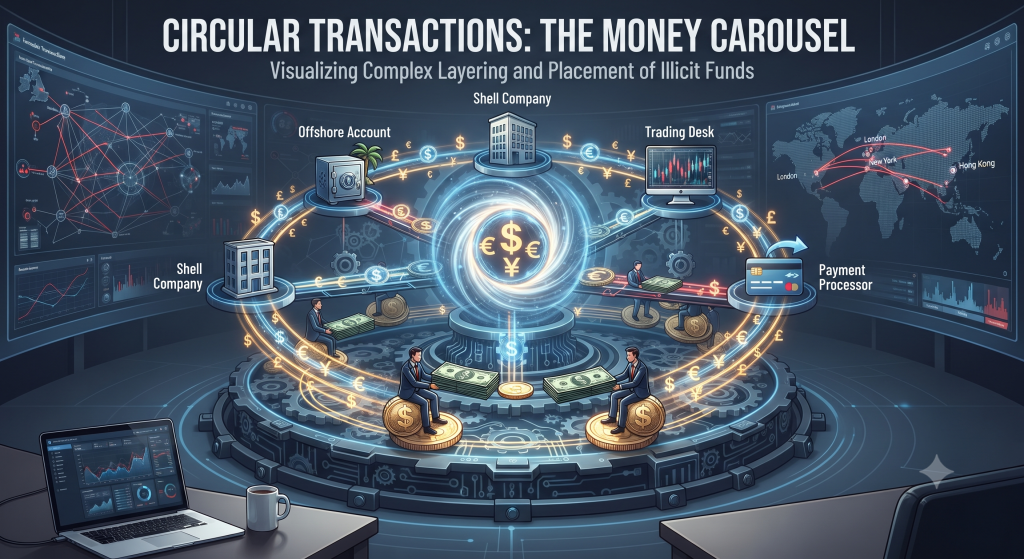
Another common technique involves circular fund movements.
Money moves between multiple companies controlled by the same group and continue a vicious circle..
Each transfer creates the appearance of genuine business activity.
Bank statements show substantial turnover.
Sales appear impressive.
Cash flows seem healthy.
Yet no real economic activity occurs.
The same money simply travels in circles.
Without careful analysis, these transactions appear legitimate.
Modern data analytics can detect such patterns, but human judgment remains essential.
Whenever unusually high turnover is accompanied by limited profitability or repetitive transaction patterns, deeper investigation becomes necessary.
When Third-Party Reports Become Weak Links
Banks rely on professionals.
Chartered accountants certify accounts.
Valuers estimate property values.
Lawyers examine title deeds/documents.
Technical experts inspect projects.
Most professionals perform their duties with integrity.
However, fraud occurs when borrowers manipulate or influence these independent opinions.
An inflated valuation.
A casual legal opinion.
An incomplete technical inspection.
Each weak report strengthens a fraudulent proposal.
Independent reports should therefore be treated as valuable inputs—not unquestionable truths.
Why Experienced Bankers Sometimes Miss Fraud
People often ask, “How could experienced officers approve fraudulent loans?”
The answer lies in human psychology.
Credit officers and Branch Heads together process hundreds of proposals every year.
Most borrowers are genuine.
Experience creates confidence.
Confidence sometimes becomes assumption.
Assumption reduces skepticism.
Fraudsters exploit exactly this sequence.
They behave professionally.
They cooperate fully.
Additionally, they maintain regular communication.
They appear transparent.
Their confidence encourages trust.
The fraud succeeds not because officers are careless, but because fraudsters carefully manage perceptions.
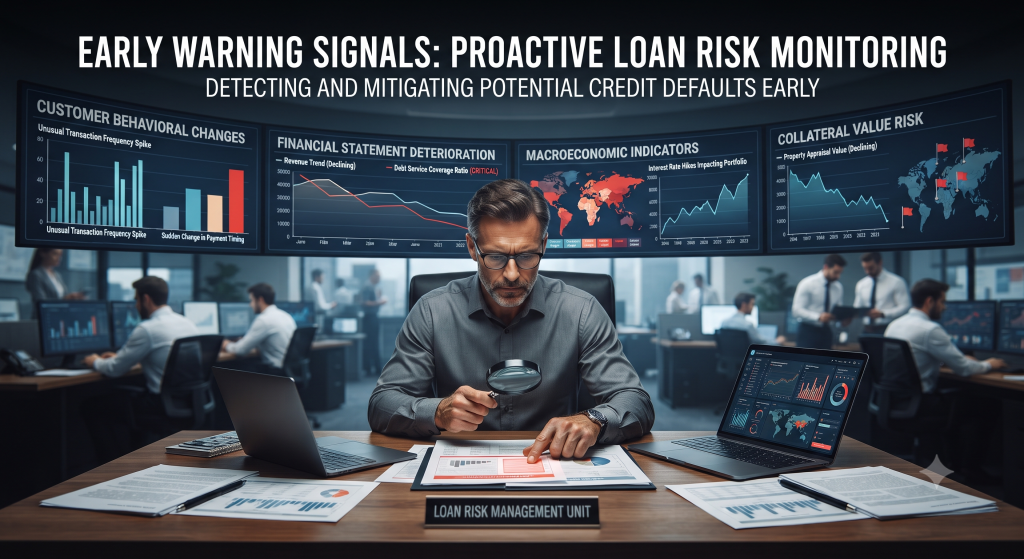
Every major loan fraud leaves clues long before default.
Some of the most common warning signs include:
- Rapid business growth without corresponding infrastructure.
- Significant increases in turnover despite industry decline.
- Frequent changes in business addresses.
- Delays in statutory payments.
- Unusually high related-party transactions.
- Reluctance to permit surprise inspections.
- Identical stock statements month after month.
- Sharp increases in receivables.
- Excessive dependence on a few customers.
No single indicator proves fraud.
However, multiple warning signs deserve immediate attention.
The Cost of Ignoring Red Flags
When fraud is detected, financial loss is only one consequence.
Recovery litigation can continue for years.
Employees face investigations/Staff accountability.
Customers lose confidence.
Regulators demand explanations.
Shareholders question governance.
Reputation suffers.
Perhaps the greatest loss is trust.
A bank can rebuild capital.
Rebuilding credibility takes much longer.
Building Stronger Defences
Preventing loan fraud requires more than checklists.
It requires curiosity.
Bankers should ask:
“Does this business model make sense?”
“Can the reported turnover realistically be achieved with existing infrastructure?”
“Are cash flows consistent with reported profits?”
“Do GST returns, income tax records, electricity consumption, and production capacity tell the same story?”
Unexpected questions often expose hidden weaknesses.
Technology can strengthen these efforts.
Artificial intelligence can identify unusual transaction patterns.
Geo-tagged inspections reduce false reporting.
Digital verification confirms document authenticity.
Centralized databases help identify multiple financing.
Yet technology works best when combined with informed human judgment.
The Ethics Behind Credit Decisions
Loan appraisal is not merely a financial exercise.
It is a responsibility.
Every sanctioned loan represents depositors’ money.
Every approval reflects public trust.
Credit officers therefore serve not only their institutions but also society.
Business targets matter.
Growth matters.
Customer service matters.
But none should come at the cost of due diligence.
Responsible banking requires balancing commercial opportunity with prudent risk management.
Lessons for Young Bankers
For professionals beginning their banking careers, loan appraisal is one of the most rewarding responsibilities.
It is also one of the most demanding.
Remember these principles:
Never confuse complete documentation with complete verification.
Visit business premises more than once whenever necessary.
Observe operations instead of merely checking files.
Understand industries before analysing financial statements.
Question unusual growth.
Document observations honestly.
Never allow business pressure to compromise professional judgment.
Most importantly, remain curious.
Fraud survives where curiosity ends.
A Message to Honest Borrowers
The overwhelming majority of borrowers are genuine entrepreneurs working hard to build sustainable businesses.
They should never view due diligence as an obstacle.
Verification protects both the bank and the borrower.
Transparent records, timely disclosures, and proper utilisation of funds strengthen long-term banking relationships.
Trust grows strongest when supported by transparency.
Conclusion
The most sophisticated loan frauds rarely rely on missing documents or forged signatures alone.
They rely on something far more powerful—convincing stories supported by convincing paperwork.
Fraudsters understand that people naturally trust organised files, professional language, and apparent compliance.
The challenge for bankers is to look beyond the file.
Every balance sheet should tell a believable business story.
Moreover, every valuation should withstand independent scrutiny.
Every inspection should verify reality rather than confirm assumptions.
The safest loan is not the one with the thickest file.
It is the one whose documents, operations, financial performance, and promoter integrity all tell the same consistent story.
In banking, paperwork is essential—but it is never enough. Sound judgment, independent verification, and healthy skepticism remain the strongest safeguards against fraud.
As lending becomes increasingly digital and fraud techniques become more sophisticated, one timeless principle continues to guide prudent bankers:
“Trust the documents—but verify the business behind them.”
In Chapter 3 – Cyber Criminals vs. Banks: The Invisible Battlefield, we will examine how cybercriminals exploit phishing, malware, deepfakes, social engineering, and artificial intelligence to steal millions without ever entering a bank branch—and how banks and customers can stay one step ahead.
PLEASE NOTE “The persona of Arjun Enterprises is entirely illustrative, bearing no relation to any actual person, living or deceased.”