
The Invisible Battlefield
“The modern bank robber doesn’t wear a mask or carry a gun. He carries a laptop, writes malicious code, and can steal millions without ever stepping inside a bank.”
Introduction
There was a time when banking fraud meant forged signatures, counterfeit currency, fake cheques, or fabricated loan documents. Fraudsters had to physically enter a bank branch or manipulate paper records to steal money.
Those days are largely behind us.
Today, the battlefield has shifted from the banking hall to cyberspace. The strongest vaults, the tallest buildings, and the most sophisticated CCTV systems offer little protection against a criminal who operates from thousands of kilometres away with nothing more than a laptop, an internet connection, and an understanding of human psychology.
Banks have embraced digital transformation. Mobile banking, internet banking, Unified Payments Interface (UPI), digital wallets, instant payments, cloud computing, and artificial intelligence have made banking faster and more convenient than ever before. Yet these same innovations have also expanded the attack surface for cybercriminals.
The challenge facing banks today is no longer simply protecting cash. It is protecting data, identities, digital transactions, and customer trust.
Welcome to the invisible battlefield.
A Typical Morning That Changed Everything
It was 9:15 a.m. when Meera, a school teacher, received a phone call.
The caller introduced himself as a bank officer.
He spoke politely, knew her name, mentioned the last four digits of her account number, and informed her that her account would be temporarily blocked unless she completed an urgent KYC update.
Concerned, Meera followed the instructions.
She clicked on a link sent through SMS.
A webpage resembling her bank’s official website appeared.
She entered her customer ID, password, and debit card details.
Moments later, she received an OTP.
The caller calmly explained that it was only for verification.
Within five minutes, ₹4.75 lakh had disappeared from her account.
The bank’s systems were functioning perfectly.
No vault had been broken.
No cheque had been forged.
No employee had stolen money.
The criminal had simply convinced the customer to unlock the door herself.
This is the essence of modern cybercrime.
The New Face of Banking Crime
Cybercriminals rarely attack technology alone.
They attack people.
Computers follow instructions.
Humans make decisions.
Hackers know that convincing one person is often easier than breaking into a secure banking server.
This technique is known as social engineering—the art of manipulating people into revealing confidential information or performing actions that compromise security.
In many cyber frauds, technology plays only a supporting role.
Psychology does the real work.
Phishing: The Digital Fishing Hook
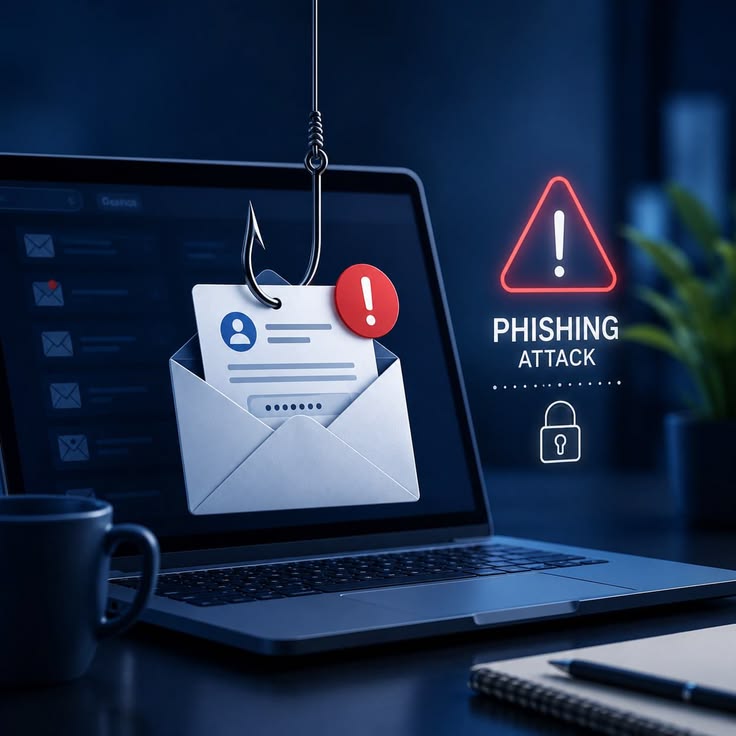
Imagine receiving an email that appears to come from your bank.
The logo is correct.
The language is professional.
The sender’s address looks genuine.
The email warns that your account will be suspended unless you verify your details immediately.
A convenient link is provided.
Many people click without hesitation.
Instead of opening the bank’s website, the link leads to a fake page resembling 99% with original Bank’s website & designed to capture usernames, passwords, card details, and OTPs.
Within minutes, stolen credentials are used to access genuine accounts.
Like a fisherman using bait, cybercriminals patiently wait for someone to take the hook.
Vishing: When Trust Has a Voice
Unlike phishing, vishing uses voice calls instead of emails.
Fraudsters impersonate bank officials, police officers, telecom providers, insurance executives, or government agencies.
Their objective is simple—to create urgency.
“Your account has been frozen.”
“Your PAN is linked to suspicious activity.”
“Your mobile number will be disconnected.”
Fear reduces critical thinking.
Victims comply before verifying.
Modern criminals even use caller ID spoofing to make their phone numbers appear legitimate.
The conversation sounds authentic.
The danger is real.
Malware: The Silent Intruder
Sometimes criminals do not need passwords.
Instead, they infect computers or smartphones with malicious software.
A customer unknowingly downloads an application.
An employee opens an infected email attachment.
A fake software update installs spyware.
The malware quietly records keystrokes, captures passwords, and transmits confidential information to criminals.
Unlike traditional theft, victims often remain unaware for weeks.
The attack happens silently.
The Rise of Deepfakes and Artificial Intelligence

Artificial intelligence has become one of the greatest innovations of our time.
Unfortunately, it has also become a powerful weapon for cybercriminals.
AI can imitate voices with remarkable accuracy.
Fraudsters can clone a company director’s voice and instruct employees to transfer funds.
Deepfake videos can mimic senior executives.
Fake identities can pass basic verification checks.
Imagine receiving a video call from your manager requesting an urgent payment.
The face looks familiar.
The voice sounds genuine.
Yet neither belongs to the real person.
The era of “seeing is believing” is rapidly coming to an end.
Banks must now verify not only documents but also digital identities.
Attacking the Bank from the Inside
Not every cyberattack targets customers.
Banks themselves are attractive targets.
Cybercriminals search for weaknesses in internal systems.
They exploit outdated software.
They target third-party vendors.
They compromise employee credentials.
Sometimes a single weak password opens the door to an entire network.
In other cases, ransomware encrypts critical banking systems, demanding huge payments to restore operations.
The financial loss may be significant.
The reputational damage can be even greater.
Why Banks Are Prime Targets
Banks manage something criminals value more than cash—information.
Customer identities.
Account numbers.
Payment credentials.
Credit histories.
Business transactions.
Financial intelligence.
Stealing this data enables identity theft, fraudulent loans, account takeovers, and financial extortion.
The digital economy has made data one of the world’s most valuable assets.
Where valuable assets exist, criminals inevitably follow.
The Human Firewall
Banks invest heavily in cybersecurity infrastructure.
Firewalls.
Encryption.
Intrusion detection systems.
Security operation centres.
Artificial intelligence.
Continuous monitoring.
Yet cybersecurity experts often repeat one important truth:
“The strongest firewall is an informed employee.”
One careless click can bypass millions of rupees worth of security infrastructure.
Every employee therefore becomes part of the bank’s cyber defence system.
Awareness is not optional.
It is essential.
The Customer’s Role in Cybersecurity
Banks cannot fight cybercrime alone.
Customers are equally important.
Simple habits significantly reduce risk.
Never share OTPs.
Never disclose passwords.
Never install unknown applications.
Always verify suspicious calls.
Use official banking applications only.
Enable transaction alerts.
Regularly update mobile devices.
Cybersecurity is a shared responsibility.
The safest customer is not the most technologically advanced.
It is the most cautious.
Early Warning Signs of a Cyberattack
Cyber incidents often leave subtle clues before major damage occurs.
Unexpected login notifications.
Multiple failed password attempts.
Transactions that customers do not recognise.
Unusual account activity late at night.
Repeated requests to reset passwords.
Employees receiving identical suspicious emails.
Systems suddenly slowing down.
Unexpected software installations.
Recognising these warning signs early often prevents significant losses.
How Banks Are Fighting Back
The banking industry has transformed cybersecurity into one of its highest priorities.
Modern banks now employ advanced fraud monitoring systems capable of analysing millions of transactions in real time.
Artificial intelligence identifies unusual spending patterns.
Behavioural analytics detects abnormal customer behaviour.
Multi-factor authentication adds additional verification.
Geo-location analysis identifies impossible travel scenarios.
Biometric authentication reduces dependence on passwords.
Threat intelligence teams continuously monitor emerging cyber risks.
Cybersecurity has become a continuous process rather than a one-time investment.
Building a Cyber-Resilient Culture
Technology alone cannot defeat cybercrime.
Banks must build a culture where security becomes everyone’s responsibility.
Regular cyber drills prepare employees for simulated attacks.
Phishing awareness campaigns improve vigilance.
Incident reporting should be encouraged without fear of blame.
Senior leadership must actively support cybersecurity initiatives rather than treating them as purely technical issues.
Cybersecurity is no longer an IT function.
It is a business function.
Lessons from Every Cyber Fraud
Every successful cyberattack teaches the same lesson.
The weakest point is rarely the technology.
It is usually trust.
Trust without verification.
Urgency without confirmation.
Convenience without caution.
Cybercriminals understand that humans naturally respond to authority, fear, curiosity, and urgency.
Banks must therefore protect not only systems but also decision-making.
The best cybersecurity strategy combines advanced technology with informed people.
Looking Towards the Future
The future of banking will be even more digital.
Artificial intelligence will automate lending.
Blockchain will transform payments.
Digital currencies may redefine financial systems.
Open banking will increase connectivity.
Each innovation will create new opportunities.
Each innovation will also introduce new cyber risks.
Cybersecurity will no longer be a competitive advantage.
It will become a prerequisite for survival.
Banks that continuously invest in resilience, employee education, customer awareness, and adaptive technology will remain better prepared for the evolving threat landscape.
Conclusion
The battle between banks and cybercriminals has no finish line.
Every day, banks strengthen their defences.
Every day, criminals search for new vulnerabilities.
The contest is continuous.
Unlike traditional bank robberies, cybercrime leaves no broken locks or shattered windows.
Instead, it quietly exploits trust, technology, and human behaviour.
The future of banking depends not only on stronger software but also on wiser decisions.
Every employee who verifies before acting.
Every customer who questions before clicking.
Every manager who prioritises security over convenience.
Together, they form the strongest defence against cybercrime.
The invisible battlefield may never disappear, but preparedness can ensure that banks remain one step ahead of those who seek to exploit the digital world.
Because in modern banking, the greatest asset is no longer cash in the vault—it is trust in the digital ecosystem. Protecting that trust is the responsibility of every banker, every customer, and every institution that powers the financial world.
In Episode 4 – The Insider Threat: When the Enemy Is Within, we will explore one of the most challenging forms of banking fraud: how trusted employees, vendors, and business partners sometimes become the architects of financial crime, why insider fraud is difficult to detect, and what banks can do to build a culture where integrity is as important as profitability.